
Comparisons & Fees
USDT vs USDC: Which Stablecoin Should You Hold?
Both track the dollar, but they differ in reserves, transparency, liquidity and where you can actually use them in Latin America. A practical comparison rather than a tribal one.
Both are digital dollars. Both are supposed to be worth exactly one US dollar, always. So the question of which one to hold sounds trivial until you notice that in Latin America they behave quite differently in the one place that matters most: actually converting them into local currency.
The short answer
In Latin America, USDT is the practical default and USDC is the conservative alternative. Not because one is good and the other bad, but because P2P liquidity in pesos overwhelmingly sits on USDT, while USDC scores better on the transparency dimension. Most people end up holding USDT because that is what the local market trades — and that is a defensible reason, as long as it is a decision rather than an accident.
Where they actually differ
| Dimension | USDT (Tether) | USDC (Circle) |
|---|---|---|
| Market size | largest stablecoin by a wide margin | second, substantial |
| P2P liquidity in LATAM | dominant — most ads, tightest spreads | thinner, varies by country |
| Reserve transparency | attestations published, historically the more contested | regulated-issuer posture, more conventional reporting |
| Network availability | on essentially every major chain | on most major chains |
| Exchange support | universal | universal on major venues |
| Typical use in the region | the on-ramp and off-ramp currency | savings and DeFi |
Reserves and transparency, without the tribalism
This is where most arguments happen, so it is worth being precise about what is and is not known.
Both issuers publish information about the assets backing their tokens. USDC's issuer has consistently operated with a more conventional regulated-institution posture. Tether has historically faced more scrutiny over the composition of its reserves and the form of its disclosures, and it has adjusted its reporting over the years in response.
Both publish this material openly, and you can read it yourself rather than take anyone's word for it. Tether runs a transparency page with daily-refreshed circulation figures per blockchain:
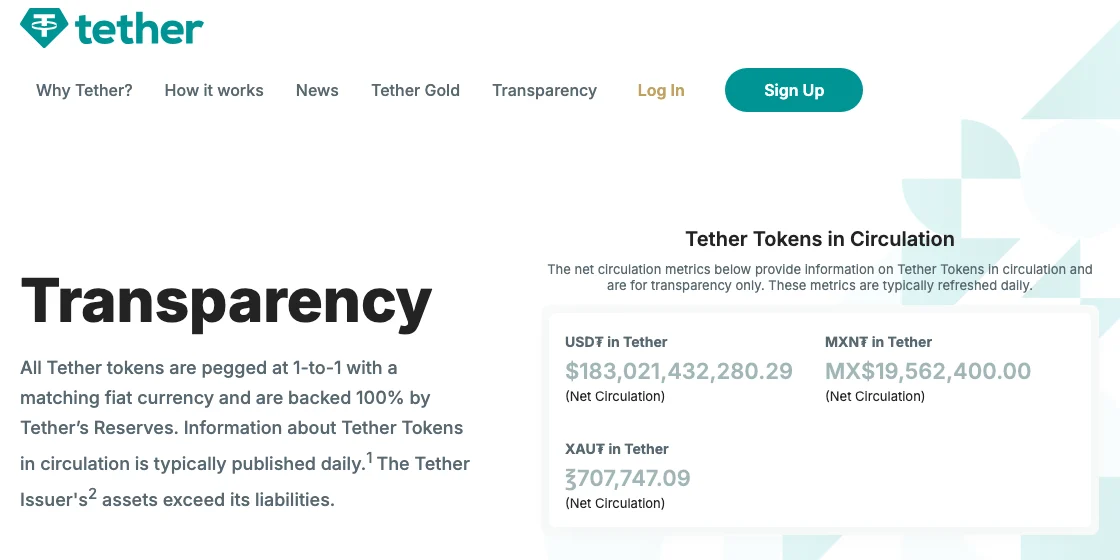
Tether's transparency page, showing net circulation and the date of the last update.
Circle positions USDC explicitly around its regulated status:
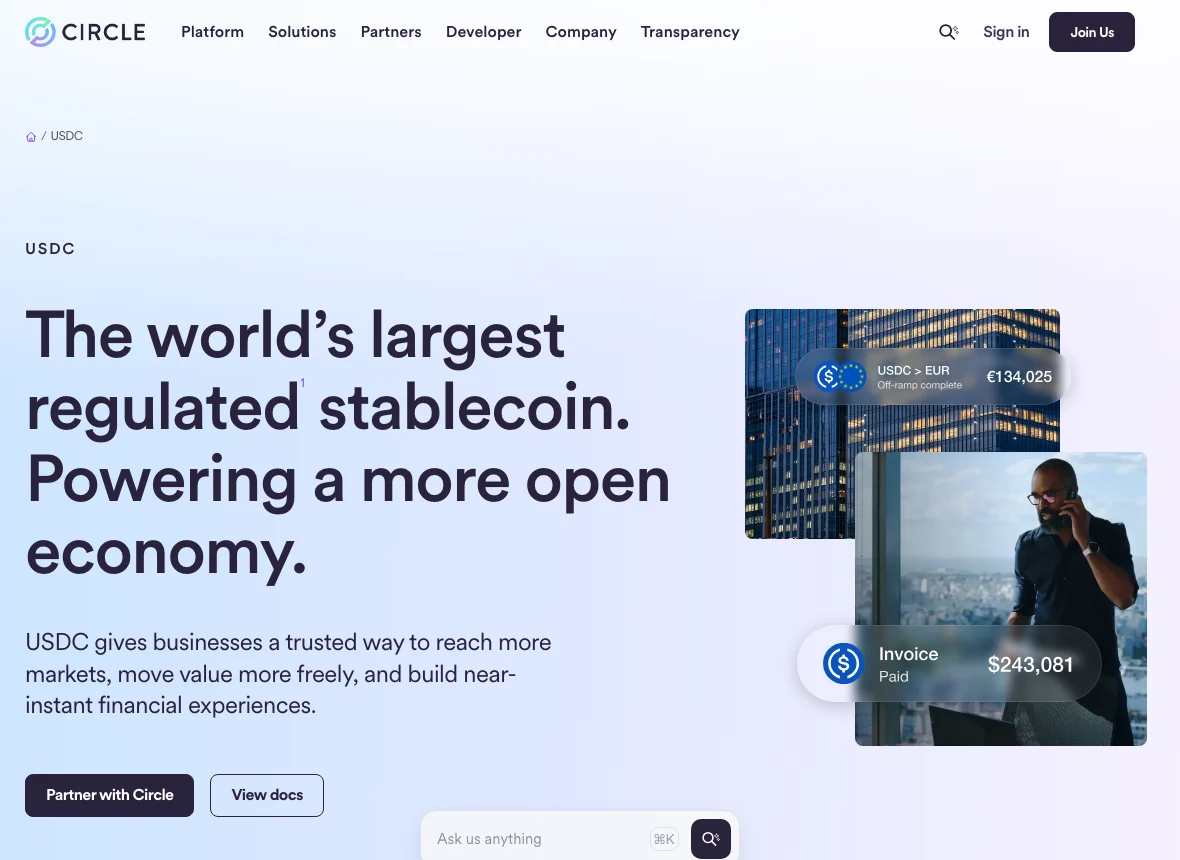
Circle's USDC page. "Regulated" is the claim the company leads with — worth understanding what it covers in your jurisdiction.
The honest summary: USDC's transparency profile is the more conservative one, and USDT's scale and liquidity are unmatched. Anyone telling you USDT is a guaranteed collapse, or that USDC has no risk at all, is selling you a position rather than describing reality.
The risk nobody prices until it happens
A stablecoin's promise is that one token equals one dollar. A depeg is when that stops being true — and it has happened to major stablecoins, in both directions, usually for hours to days rather than permanently.
The practical lessons from past episodes:
- Depegs are usually temporary but genuinely disruptive. If you need to sell during one, you take the loss.
- They tend to be triggered by the plumbing, not the token — banking exposure, redemption doubts, a market panic.
- Concentration is the actual risk. Holding your entire balance in a single stablecoin, on a single platform, is the exposure worth thinking about.
If you hold meaningful amounts long term, splitting across both is a reasonable hedge. If you are moving money in and out this week, it barely matters.
What actually decides it for most people
Forget the ideology; in day-to-day use, three things decide:
Can you sell it for pesos easily? In most of the region, USDT P2P markets are deeper — more ads, more payment methods, tighter spreads. That is a concrete, measurable advantage every time you cash out. See the country guides for Argentina, Chile, Peru and Colombia.
What does it cost to move? Both live on multiple networks, and the network you pick matters far more than which stablecoin you hold. Sending either over ERC20 costs several dollars; over TRC20, Polygon or Solana, a fraction of that. Full breakdown in the cheapest network to send USDT.
Where are you holding it? A stablecoin sitting on an exchange carries that exchange's risk on top of the issuer's. Both major exchanges publish monthly proof-of-reserves attestations you can check against your own balance — a one-minute habit that addresses the platform half of the risk, though not the issuer half.
Exchange proof of reserves covers the platform holding your tokens, not the company issuing the stablecoin. They are two separate risks. That question — platform versus your own wallet — is covered in exchange or own wallet.
A practical rule
- Moving money in and out, or trading actively: USDT. The liquidity is where you need it.
- Parking a larger amount for months: consider splitting, or leaning USDC if transparency is what lets you sleep.
- Either way: do not keep everything in one stablecoin on one platform, and do not chase a yield product promising unusual returns on a stablecoin — that is a separate risk, discussed in Binance Earn: yields and risks.
FAQ
Is USDT safe? It is the largest and most liquid stablecoin, and it has maintained its peg through multiple stress events. It also carries issuer risk, as every stablecoin does. "Safe" is not the right frame; "what is my concentration" is.
Which is better for P2P in Latin America? USDT, clearly, on liquidity grounds.
Can I convert between them? Yes, on any major exchange, usually with minimal spread. Just remember the network rule when withdrawing either one.
Does the network change which one I should hold? No, but it changes your cost to move it. Pick the stablecoin on liquidity, pick the network on fees.
Affiliate disclosure: this article contains referral links. If you sign up for OKX (code OK6669) or Binance (code BNB6669) through our links, you get a 20% discount on trading fees and this site earns an affiliate commission, at no extra cost to you.
Risk warning: cryptocurrencies are volatile, high-risk assets; you may lose your entire capital. This content is educational and informational only and is not financial, legal or tax advice. Do your own research before trading.
Regional notice: this site is written for readers in Latin America (Argentina, Mexico, Colombia, Chile, Peru and others). It is not directed at residents of mainland China, the United States, the United Kingdom or Canada. Always check and comply with the regulations in your country.