
P2P, Deposits & Withdrawals
Cheapest Network to Send USDT: Fees Compared (2026)
Picking the wrong network when sending USDT can cost you several dollars — or the entire transfer. Fee and speed comparison of TRC20, ERC20, BEP20, Polygon and Solana in 2026.
When you withdraw USDT from Binance or OKX, the app asks a question that confuses every newcomer: which network? The wrong answer costs you a few extra dollars — or, if the receiving wallet doesn't support that network, the entire transfer. Here's the practical 2026 comparison and the one rule that makes mistakes impossible.
What "network" means
USDT is the same digital dollar issued on several different blockchains. Sending via TRC20 (Tron), ERC20 (Ethereum), BEP20 (BNB Chain), Polygon or Solana is like choosing which courier carries the same parcel: cost and speed change, the contents don't.
Network comparison for USDT (2026)
| Network | Typical withdrawal fee | Speed | When to use it |
|---|---|---|---|
| TRC20 (Tron) | ~1 USDT | 1–3 min | the de facto standard between exchanges |
| ERC20 (Ethereum) | several USD, congestion-dependent | 1–5 min | only when the destination requires Ethereum (DeFi) |
| BEP20 (BNB Chain) | < 1 USDT | 1–3 min | between platforms that both list it |
| Polygon | cents | 1–3 min | very cheap where supported |
| Solana | cents | seconds | increasingly supported, extremely fast |
Exact fees move with congestion and are shown on the withdrawal screen — treat the table as an order of magnitude and always check the fee the app displays before confirming.
How to check the cheapest network yourself (30 seconds)
Any fee table ages badly, so the useful skill is reading the live number instead of trusting an article. On both Binance and OKX the flow is the same: start a withdrawal, pick USDT, choose the destination type, and the network selector shows the current fee next to each network before you commit to anything.
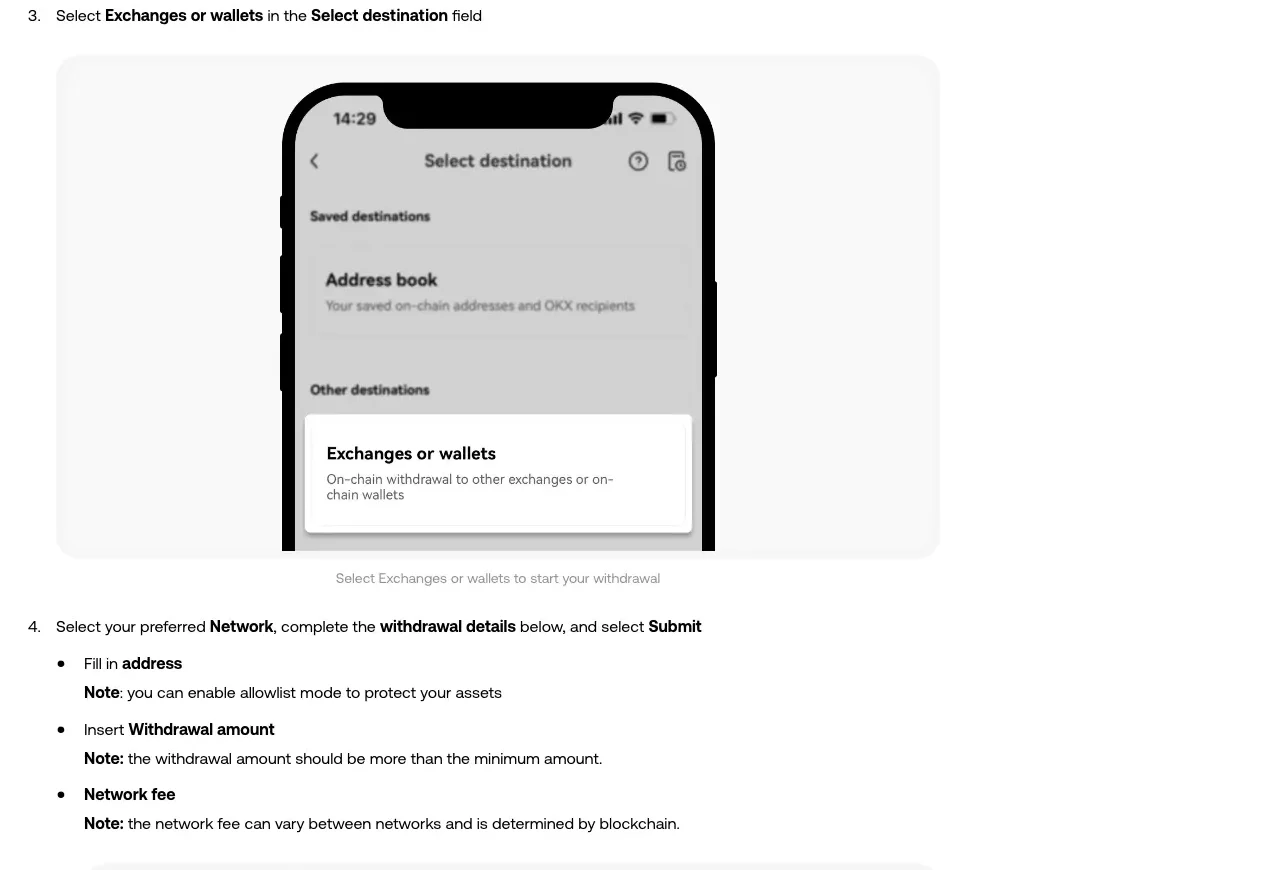
Official reference: OKX's crypto-withdrawal help pages. Binance's flow differs only in wording.
The number shown there is the one you will actually pay. If it disagrees with the table above, the screen is right and the table is stale.
The one golden rule
Both ends decide the network. Origin and destination must support exactly the same network. If the destination doesn't list the network you chose at origin, funds can be lost with no recovery.
Three habits follow from it and prevent virtually every accident:
- Copy the deposit address from the destination platform and check which networks that address accepts.
- Select exactly the same network at origin — the name must match, not "look similar".
- First transfer to a new destination: send a small test amount. One extra dollar of fees is the cheapest insurance in crypto.
Why BEP20 and ERC20 get confused so often
This pair causes more lost transfers than all the others combined, for a mechanical reason: BNB Smart Chain and Ethereum use the same address format, so your deposit address looks byte-for-byte identical on both. Nothing in the address itself tells you which chain it belongs to, which means a wrong pick doesn't bounce — it succeeds, on the wrong blockchain.
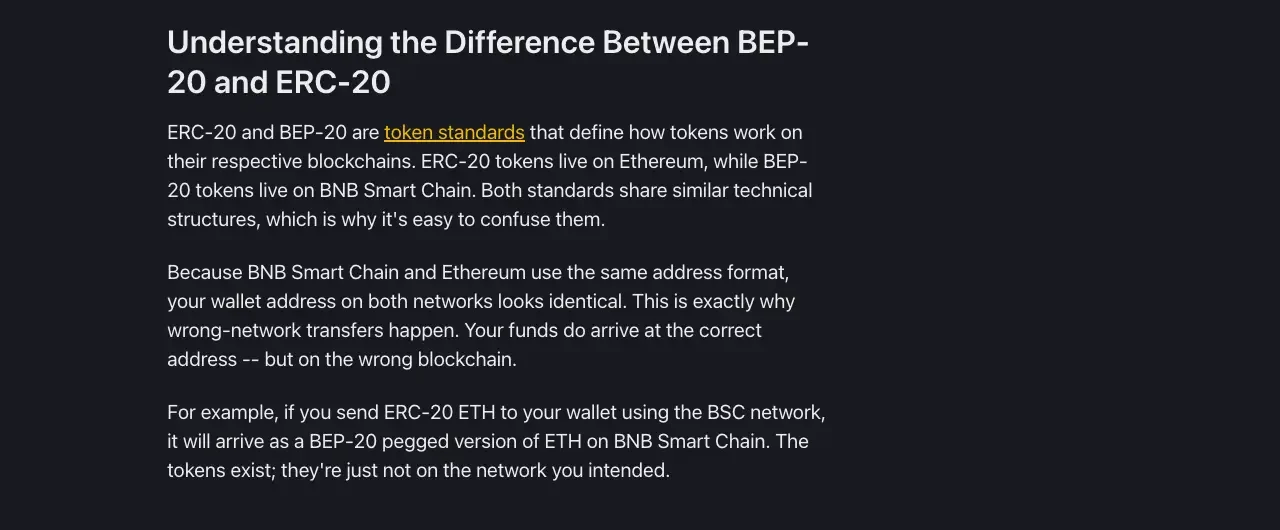
Official reference: Binance Academy on recovering crypto sent to the wrong network.
The practical consequence: for these two networks, "the address was correct" is never proof that the network was. Only the selector at origin decides.
Typical cases in Latin America
- Binance ↔ OKX: TRC20 is the standard — cheap and universally supported. BEP20 or Polygon also work when both ends list them.
- Exchange → local exchange to cash out to your bank: check the local platform's supported networks; TRC20 is almost always there.
- Exchange → your own wallet for DeFi: this is where ERC20 or a protocol-specific network may be required; the higher fee is the cost of that ecosystem.
Common mistakes (and what to do)
Used ERC20 unnecessarily and overpaid. Money lost on fees isn't recoverable, but the funds arrived. Next time: TRC20.
Sent via a network the destination doesn't support. Contact the destination's support: if they control the address on that chain, some exchanges can recover funds (sometimes for a fee); if not, there's no fix. This is exactly why test transfers exist.
Forgot a required memo/tag. Some platforms need it to credit deposits; without it the transfer sits in limbo until you open a ticket with the transaction hash.
FAQ
Does the network change how many USDT arrive? Only via the fee — the app shows the exact net amount before you confirm.
Cheapest network on Binance and OKX? Among major options, Polygon and Solana are usually cheapest, with TRC20 the best balance of cost and universal compatibility. For everything else you'll pay these exchanges, see Binance vs OKX in Latin America.
Same rules for USDC? Identical logic: both ends define the network, test transfer first.
Bottom line
TRC20 between exchanges, Polygon or Solana when both ends support them and you want minimum cost, ERC20 only when the destination demands it. Same network on both ends plus a test transfer, and you'll never lose a dollar to a network mistake. Trading fees themselves are 20% cheaper if you registered with BNB6669 on Binance or OK6669 on OKX.
Affiliate disclosure: this article contains referral links. If you sign up for OKX (code OK6669) or Binance (code BNB6669) through our links, you get a 20% discount on trading fees and this site earns an affiliate commission, at no extra cost to you.
Risk warning: cryptocurrencies are volatile, high-risk assets; you may lose your entire capital. This content is educational and informational only and is not financial, legal or tax advice. Do your own research before trading.
Regional notice: this site is written for readers in Latin America (Argentina, Mexico, Colombia, Chile, Peru and others). It is not directed at residents of mainland China, the United States, the United Kingdom or Canada. Always check and comply with the regulations in your country.