
P2P, Deposits & Withdrawals
How to Withdraw Money from Binance in Mexico via SPEI (2026)
USDT to Mexican pesos in your bank account: sell on P2P and get paid by SPEI to any CLABE — BBVA, Banorte, Santander. Real costs, timing, and the seller-side scams to dodge.
Cashing out of Binance into a Mexican bank runs best through the P2P market: sell USDT, get paid in pesos via SPEI to your CLABE at BBVA, Banorte, Santander, HSBC or any other bank. SPEI settles in minutes, around the clock — which quietly makes Mexico one of the easiest off-ramps in Latin America. Here's the full process, what it truly costs, and the seller-side frauds you must be able to spot.
What you need first
- Binance with KYC completed — P2P is unavailable otherwise.
- Balance in USDT; nearly all MXN liquidity trades against it, so convert other coins on spot first.
- A bank account in your own name. P2P rules require the payer/payee names to match the verified order parties; third-party payments are both against the rules and the signature of fraud.
Step by step: sell USDT, receive SPEI
- Open P2P → Sell → USDT → MXN.
- Filter for bank transfer (SPEI) and compare a few ads: price, completion rate ≥ 97%, order volume, verified-merchant badge.
- Place the order — your USDT locks in escrow until you release it.
- The buyer sends SPEI to your CLABE. All talk stays in the order chat.
- Open your banking app and confirm the deposit is available — not an SMS, not a push, not a "CEP receipt" pasted into chat — then press Release.
That last step is everything: the number-one fraud against sellers is the fake receipt — a flawless-looking PDF for a transfer that never happened. If you ever need to check whether a SPEI transfer actually exists, Banxico runs an official CEP validator:
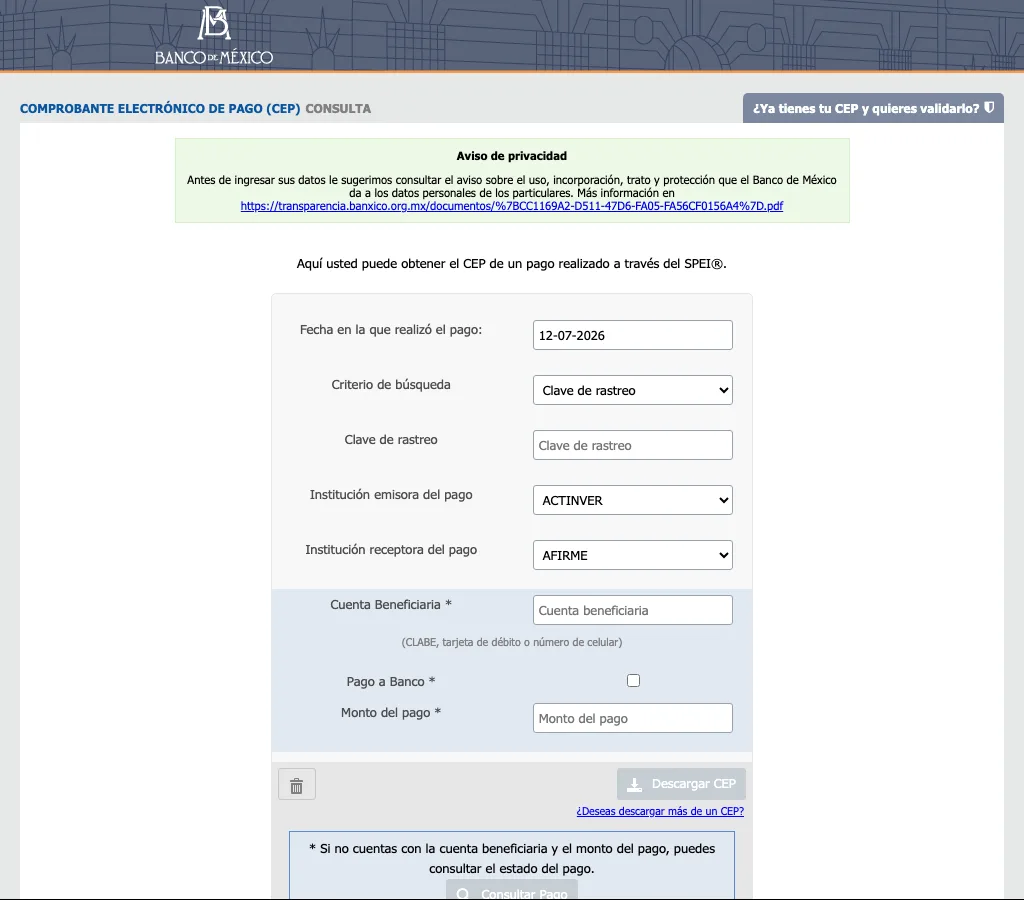
The CEP tool at banxico.org.mx/cep confirms a SPEI using the tracking key, banks and amount. Even so, the only proof that authorizes releasing crypto is money credited in your own account.
Costs and timing
| Item | Typical value |
|---|---|
| P2P fee (taking an ad) | 0% on most pairs |
| Spread vs. spot | ~0.5–1.5% — MXN is among LATAM's most liquid pairs |
| SPEI | free for you; minutes, 24/7 |
| Full order | 5–15 minutes |
For larger amounts, split across two or three verified merchants — better pricing, less exposure per counterparty.
Seller-side red flags
- Payment from a different account holder → don't release; ask to cancel. This is typically triangulation — a scammer routes a victim's money to you, and the chargeback lands on your bank account later. Full scheme in our P2P scams guide.
- Chat pressure ("I already paid, release now!") while the timer runs → the timer protects you, not them.
- "Accidental" overpayment with a request to refund the difference outside the order → disguised reversal; open an appeal instead.
What about direct withdrawal without P2P?
Depending on the period and your account, Binance has offered regulated MXN off-ramps with local partners; when available they show up under Wallet → Withdraw → MXN, with their own fees and limits. Compare against the day's P2P spread — with MXN liquidity this deep, P2P usually wins. For squeezing every basis point, see how to pay less in Binance/OKX fees.
FAQ
Does SPEI work nights and weekends? Yes — 24/7/365, minutes to settle. It's what makes the Mexican off-ramp so smooth.
Tax implications? Gains may matter to SAT. Keep your order history and ask an accountant — this is not tax advice.
I released and the payment was fake — now what? Appeal immediately with the chat log and your bank statement. Recovery is hard once crypto is released, which is why the rule has no exceptions: money visible in your banking app first.
Affiliate disclosure: this article contains referral links. If you sign up for OKX (code OK6669) or Binance (code BNB6669) through our links, you get a 20% discount on trading fees and this site earns an affiliate commission, at no extra cost to you.
Risk warning: cryptocurrencies are volatile, high-risk assets; you may lose your entire capital. This content is educational and informational only and is not financial, legal or tax advice. Do your own research before trading.
Regional notice: this site is written for readers in Latin America (Argentina, Mexico, Colombia, Chile, Peru and others). It is not directed at residents of mainland China, the United States, the United Kingdom or Canada. Always check and comply with the regulations in your country.